

Transparency of grinding beads refers to the degree to which light can pass through these beads. In the world of grinding and milling, grinding beads are indispensable tools, and their transparency is not just a visual characteristic but holds significant implications in various aspects. As a supplier of grinding beads, understanding the transparency of grinding beads and its significance can help us better meet the diverse needs of our customers.

What Determines the Transparency of Grinding Beads
The transparency of grinding beads is mainly determined by their material composition and internal structure. Different materials have different optical properties, which directly affect the way they interact with light.
Material Composition
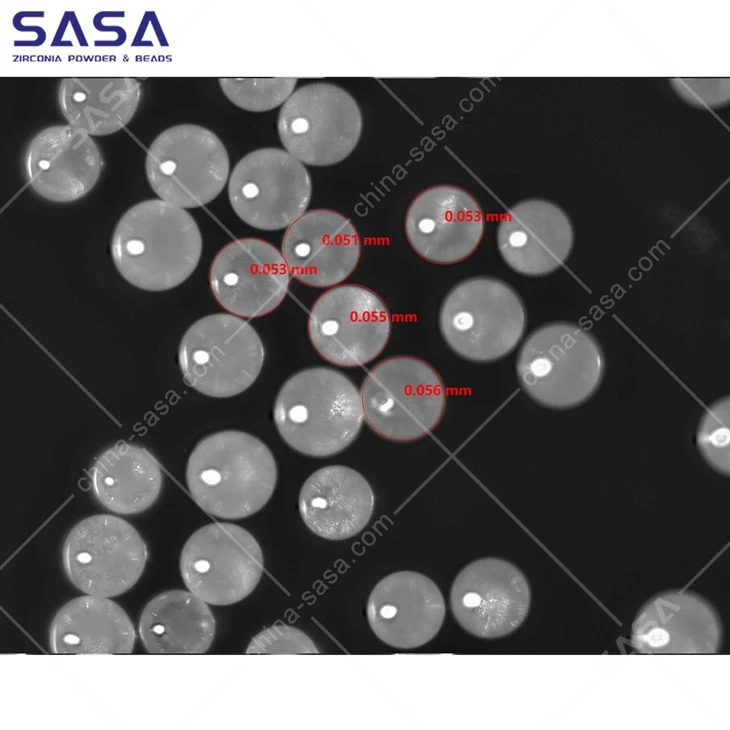
- Zirconia-based Beads: Zirconia is a commonly used material for high - performance grinding beads. 95 Zirconia Beads Formed By Dripping are known for their excellent mechanical properties and relatively high transparency. The high purity of zirconia allows light to pass through with less scattering. Zirconia has a relatively uniform crystal structure, which helps in maintaining the integrity of light propagation.
- Zirconium Silicate Beads: 64 Zirconium Silicate Powder is used to make zirconium silicate beads. These beads usually have a lower transparency compared to high - purity zirconia beads. The presence of silicon in the compound changes the refractive index and the way light is scattered within the bead. The different chemical bonds and atomic arrangements in zirconium silicate result in more light being absorbed or scattered, reducing the overall transparency.
Internal Structure
The internal structure of grinding beads, such as the presence of pores, inclusions, or crystal defects, can significantly affect their transparency. Pores within the bead can cause light to scatter in multiple directions, reducing the amount of light that can pass through in a straight line. Inclusions of foreign substances or crystal defects can also disrupt the regular propagation of light, leading to a decrease in transparency. Well - manufactured grinding beads with a dense and uniform internal structure tend to have higher transparency.
Significance of Transparency in Grinding Applications
Visual Monitoring
- Process Observation: In many grinding processes, especially in laboratory or small - scale production, the ability to visually monitor the grinding process is crucial. Transparent grinding beads allow operators to directly observe the state of the material being ground. For example, in the grinding of pigments or dyes, one can see the color change and the degree of dispersion of the particles. If the grinding beads are opaque, it is difficult to accurately assess the progress of the grinding process, and over - or under - grinding may occur.
- Detection of Contamination: Transparent grinding beads can also help in detecting contamination. If there are any foreign particles or impurities in the grinding medium, they can be easily spotted through the transparent beads. This is important for maintaining the quality of the final product, especially in industries such as pharmaceuticals and food, where strict purity standards are required.
Heat Dissipation
Transparency can be related to heat dissipation in grinding beads. Materials with higher transparency often have better thermal conductivity. When light passes through the beads, it can also transfer some of its energy as heat. Transparent beads can more efficiently dissipate this heat, preventing overheating during the grinding process. Overheating can cause thermal degradation of the material being ground and can also reduce the lifespan of the grinding beads themselves. For example, in high - speed grinding operations, the ability of the beads to dissipate heat quickly is essential for maintaining the quality of the grinding process.
Compatibility with Optical Sensors
In modern grinding systems, optical sensors are increasingly used to monitor various parameters such as particle size and concentration. Transparent grinding beads are more compatible with these optical sensors. The light from the sensors can pass through the beads and interact with the material being ground, allowing for accurate measurements. Opaque beads would block the light, making it difficult for the sensors to function properly. This is particularly important in industries where precise control of particle size is required, such as the electronics and semiconductor industries.
Significance in Quality Control
Uniformity Assessment
Transparency can be used as an indicator of the uniformity of grinding beads. Beads with consistent transparency are likely to have a more uniform internal structure and material composition. By visually inspecting the transparency of a batch of grinding beads, we can quickly assess their quality. If there are significant variations in transparency among the beads, it may indicate problems in the manufacturing process, such as uneven mixing of raw materials or inconsistent sintering conditions.
Quality Assurance for End - Users
For end - users, the transparency of grinding beads can be a sign of quality. When customers purchase grinding beads, they expect a certain level of performance and reliability. Transparent beads, which are often associated with high - quality materials and precise manufacturing processes, can give customers more confidence in the product. This is especially important in industries where the grinding process is critical to the quality of the final product, such as the production of high - end coatings and ceramics.
Significance in Research and Development
Material Studies
In research and development, the transparency of grinding beads can be used to study the interaction between the beads and the material being ground. By observing how light passes through the beads and the material, researchers can gain insights into the physical and chemical processes that occur during grinding. For example, changes in transparency over time can indicate the formation of new compounds or the alteration of the material's structure.
Development of New Grinding Technologies
Transparent grinding beads can also be used in the development of new grinding technologies. For instance, in the design of novel grinding equipment, the transparency of the beads can be used to test the flow patterns and mixing efficiency within the grinding chamber. This information can be used to optimize the design of the equipment and improve the overall grinding performance.
Our Offerings as a Grinding Beads Supplier
As a supplier of grinding beads, we offer a wide range of products with different levels of transparency to meet the diverse needs of our customers. Our 95 Zirconia Beads Formed By Dripping are highly transparent and are suitable for applications where visual monitoring and high - performance grinding are required. Our 64 Zirconium Silicate Powder - based beads are more cost - effective and can be used in applications where high transparency is not the primary concern. We also provide Zirconia Ceramic Sand, which has unique properties for sand - blasting and other surface treatment applications.
We are committed to providing high - quality grinding beads with consistent transparency and performance. Our strict quality control measures ensure that each batch of beads meets the required standards. If you are interested in our grinding beads or have any questions about the transparency and its significance, please feel free to contact us for further discussion and procurement negotiation. We look forward to serving you and meeting your grinding needs.
References
- "Ceramic Materials for Grinding and Milling" - A textbook on ceramic grinding media
- Research papers on the optical and thermal properties of zirconia and zirconium silicate materials
- Industry reports on the application of grinding beads in different sectors.